All Hail the King
Or should the title be 'To Kill the King'... An installment in Bradley's ongoing 1960s Conspiracy and Counterculture series

“There’s two kinds of people in this world, Elvis people and Beatles people. Now Beatles people can like Elvis. And Elvis people can like the Beatles. But nobody likes them both equally. Somewhere you have to make a choice... and that choice tells you who you are.” – Mia Wallace in Pulp Fiction [deleted scene]
Around here, we think that there is also a secret third way, but that’s another story. I didn’t expect to be writing or reading about Elvis, but after listening to Miguel Conner of Aeon Byte Gnostic Radio talk about his book on the King, The Occult Elvis, I fell all the way down the rabbithole.
Miguel is currently struggling with health issues, please see his Go Fund Me.
For the record, Elvis said there was only one King, and it was not him. Growing up, I was not an Elvis fan, but he was my mom’s favorite - and she happened to see his penultimate show in Ohio in 1977, less than a scant two months before he died. Most of my music these days is classical, but I did have to put on How Great Art Thou after reading Miguel’s book. And, unlike JFK, which has been alluded to be a ritual occult killing, Elvis appears to have found his Fate, i.e. his Amor Fati. I wonder if JFK knew what was going to happen to him that fateful day in Dallas, but playing the role of the King appears to be one that Elvis fully embraced and knew his ultimate fate… The lover of fate but that it is easier to embrace death than it is to live, addicted to doom, like moths to a flame. But now, on with the show.
One of the themes we’ll encounter throughout this series was categorized by Sir James Frazer in The Golden Bough as that of the dying god, the sacrificial king, and the scapegoat. With Elvis we get all three, neatly wrapped into one. He seemed resigned to his fate, as we noted, amor fati - the love of fate, even if that fate is doom. We’ll first introduce this concept through our first Brotherhood, that of the Snake. This concept of the scapegoat/sacrificial king/dying god is first introduced as the maverick - yes, the Luciferian or Promethean figure- yet it is also a figure we also see with Jesus, who ultimately serves as the ultimate sacrifice. While these thematic concepts are prevalent throughout history, the controlling mechanism seeks to constrain and confine these archetypes. However, a thorough analysis of making a deal with the devil will realize that this is also a Trickster archetype we’re dealing with. And some have an addiction, an addiction they just can’t shake, and when that addiction is doom, we know how that tale ends, all too well.
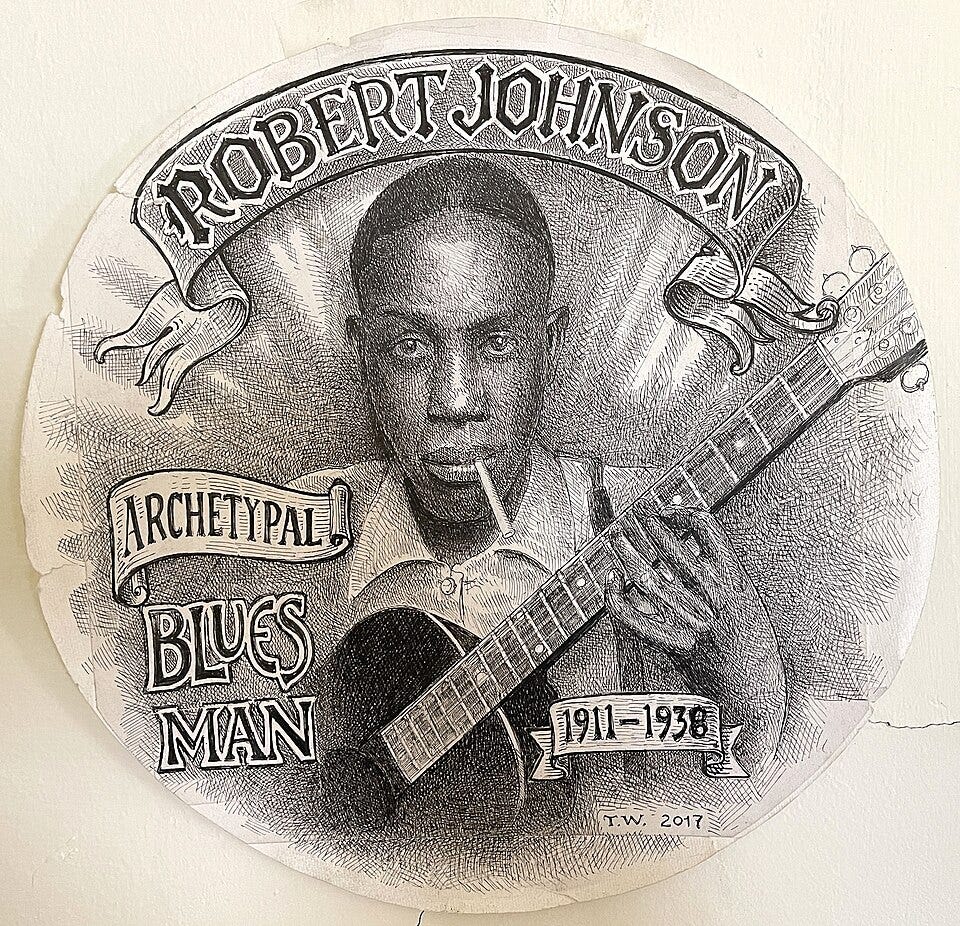
When comparing figures like Elvis and Robert Johnson, we get another synchronicity in the form of making a deal with the devil. Robert Johnson and Elvis share the same death date, that of August 16, and we’ll just leave these little nuggets here for now; Robert Johnson was the ‘first’ member of the 27 club while Elvis lived to a ripe old age of 42. I’m not sure exactly who Robert Johnson’s devil is, but we’ll introduce one of our own here called Colonel Tom Parker in just a moment. But first, I want to talk a little bit about the synthesis of east and west that we get in the Sixties, and how that begins with Elvis. He was one of the first American blackbelts in kung fu, and an early practitioner of martial arts and yoga as well as being the king of rock and roll.
Much of what we think of with the counterculture of the Sixties appears to have its genesis with Elvis. If you want the full details, then I recommend Miguel’s book, as he uses first hand accounts to tell the King’s story, and it resonates with many of our themes. In future columns, I want to discuss a few of these characters in depth such as Robert Anton Wilson, Dr. Timothy Leary, Philip K. Dick, and Alan Watts - as well as some of the other players in the Conspiracy realm like E. Howard Hunt. Egil “Bud” Krogh introduced Elvis to Nixon, and Nixon was one of the Plumbers, alongside Hunt (Hunt served 33 months for his role in the break-in, by the way). We’ll get back to Elvis the Wounded Healer in a moment, but first we want to look at his manager and Elvis’s time in West Germany in the Army. But first, we have to properly introduce the Colonel.
“Whether regarded as a meretricious and evil confidence man, or as a brilliant marketer and strategist, as remarkable as the star he managed, no figure in all of entertainment is more controversial, colorful, or larger than life than Tom Parker.” Alanna Nash, The Colonel
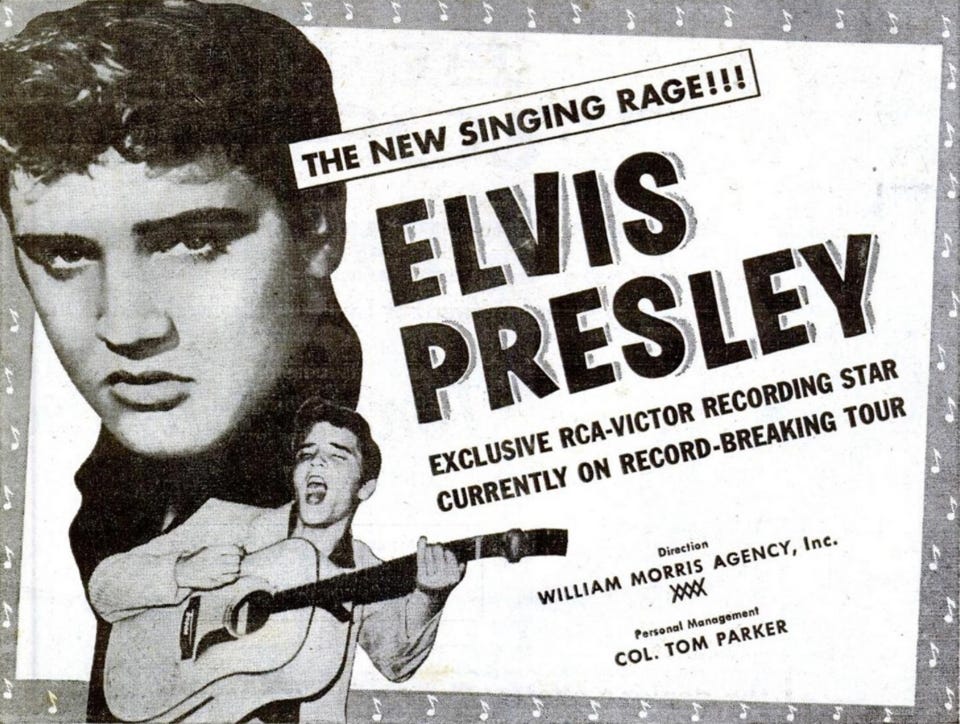
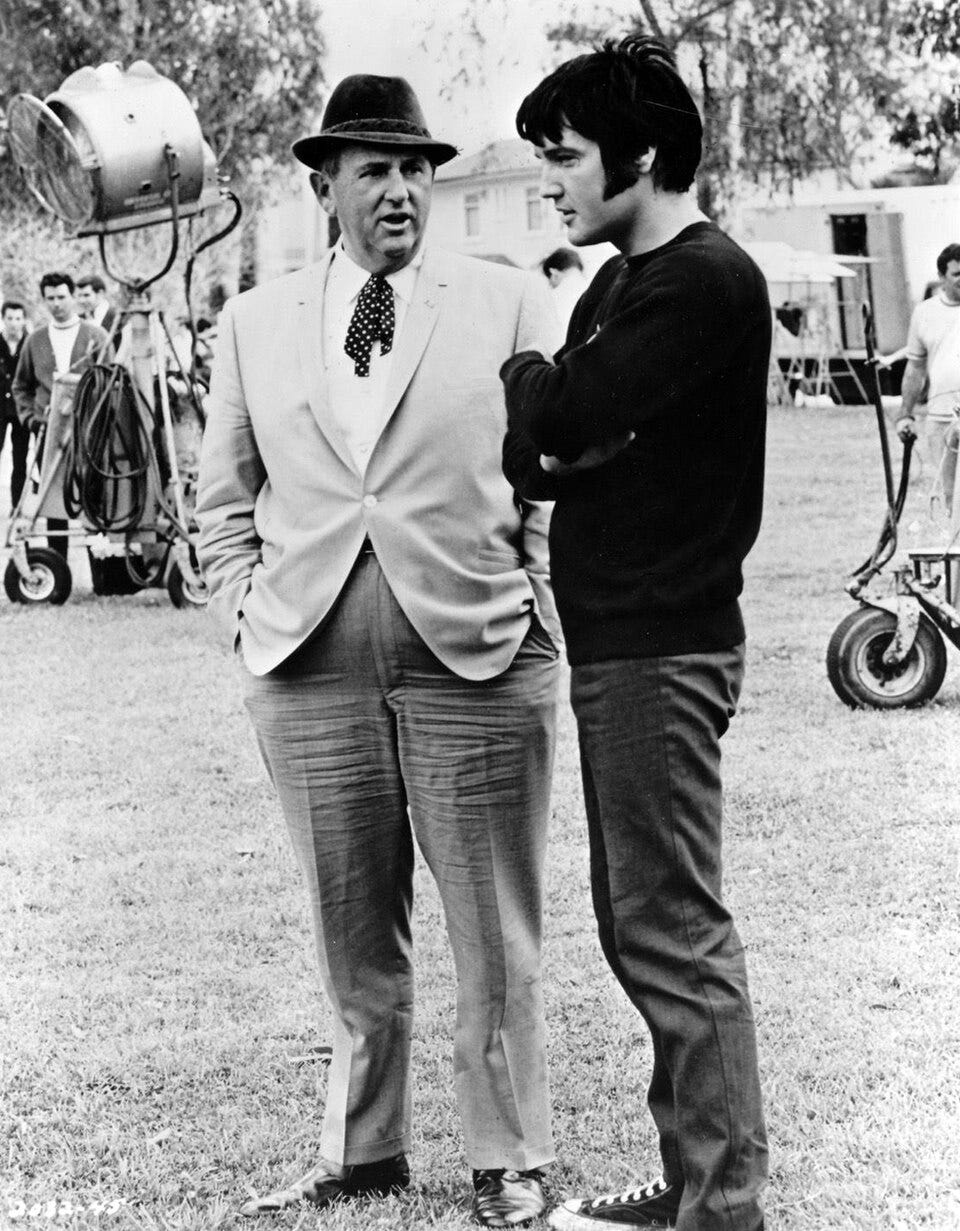
The story over the years was that Elvis kept Colonel Tom Parker around out of loyalty. It’s an interesting piece of the puzzle. Parker was actually Andreas Cornelis van Kuijk from Breda, Netherlands, which brings to mind the Dutch-Anglo network. He may or may not have killed someone. Elvis was just a local regional star, having gotten his start at Sun Records in 1954. (Note from the editor: Brad’s mom wasn’t the only Elvis fan, my grandmother claims she was the first member of the Elvis fan club when he was on the radio in Memphis. After hearing him sing and hearing the DJ make a call for local residents to come sign up, she and her friend rushed down the station to be the first signatures on the list. We wonder how many of those first members there are!) His manager at the time, Bob Neal, introduced the King to the Colonel. Interestingly, the honorary Colonel comes from Parker’s time in the Louisiana State Militia. We’re just wanting to note this curious character, perhaps nothing will come of it, but it’s a rather sad part of the story too, once you realize how badly he defrauded Elvis.
Elvis was the original rock n roll rebel.
“Rock and roll ignited a firestorm. Preachers, teachers, politicians, professors, and worried parents saw in the unbridled emotions it unleashed an express lane to immortality and crime. And lurking in the background - particularly in the South - was a perceived mixing of the races. Many white listeners, hearing Elvis on the radio, assumed he black. The unrestrained passion in his voice, and the overt sexuality in his stage performance, frightened many white leaders, who feared it could lead to breaking down the barriers of segregation (a well-founded fear, as it turned out). - Tillery, the Seeker King
We’re going to examine this from as many different angles as we can, throughout our journey together, but we wonder, did Elvis tap into this energy and just become this bigger than life figure, was it a syncreticism between him and the Universe? How much do these dubious characters around him play a role in the Rise and Fall of the King? Perhaps these are rhetorical, questions on which we shall elaborate as we study other myths and legendary figures from the ages. The cynic might sneer and think that it’s all a bunch of poppycock, that Elvis was obviously manipulated by some kind of Custodial, Control Mechanism. To us, it looks like a maverick figure that will come up with Gods of Eden and the Brotherhood of the Snake, but for now, let’s just say that the whole thing is just curious. It’s something that Elvis knew you had to experience for your own self.
Now, as it turns out, that rogue Elvis was tamed thanks to his time in the Army. Elvis was drafted in 1958. Instead of getting a special assignment, the Colonel convinced Elvis to just be a regular soldier, a Jeep driver. I have never served in the military, but my understanding is that you go through a similar initiation phase during basic training. You are broken down and built back up. Now, naturally, the real Elvis will re-emerge, but it will have been alchemized by his time served. I believe this allowed him the discipline to marry his anima and animus, which will serve him in his esoteric studies. However, I wondered about any possible intelligence ties while he was overseas. And while I’ve not been able to find any documentation that Elvis was part of any kind of connection to the Gehlen network while he was there, he does meet Priscilla. And while her family has Air Force ties, there do not appear to be any intelligence ties there, either. Perhaps it’s just a coincidence that he was stationed there. We do find it curious though, perhaps we have a suspicious nature. Elvis’s unit was also labeled as an Intelligence unit, but does not appear to bear any further fruit either, so on with our story.
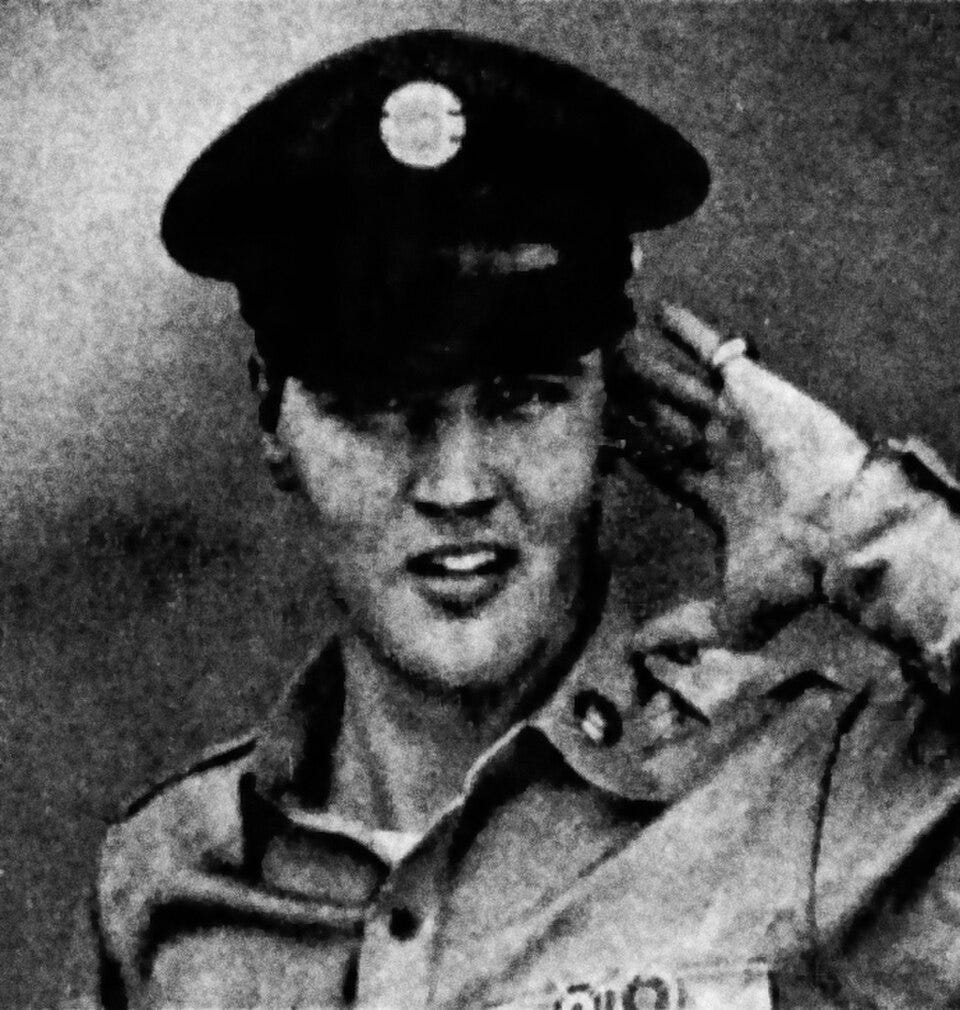
Colonel Tom’s strategy appears to have worked, Elvis came back more popular than ever, since he served his time like everyone else, and his young fans were quite excited for his return. It seems like a lot of Elvis’s inner circle over the years just thought of a lot of the things that Elvis did as Elvis being Elvis, but that’s our next topic of discussion. I was curious about this Other Side of Elvis and so I thought I would read Miguel’s book, and I’ll just let him fill in the blanks. In The Occult Elvis Miguel will:
Supply the supernatural, prophetic, and cosmic circumstances that gave rise to Elvis
Catalog his extensive interest and research in alternative spiritualities
Reveal his profound, otherworldly experiences, visionary encounters, mystic abilities, and reality-bending powers
Showcase his arcane rituals how they paved the way for modern spirituality and praxis
Make the case that Elvis was part of the machinations of higher forces that transformed Western culture forever
Provide Jungian, Steiner-oriented, alchemical, and other esoteric ideals on the rise and fall of the King, examining his self-destructive, addictive persona, and solving the perennial confounding relationship with manager Colonel Tom Parker
Present the eerie parallels between Elvis and Philip K. Dick that underscore Elvis’s remarkable abilities
We’ll get to some more PKD in a bit, but what was interesting to me was this further developing idea of the Twin. First, we were dealing with Duplicates in the Lee Harvey Oswald article, and now we’re on to the Twins. As a Gemini, I can relate, and we’ll discuss how these ideas get seeded into our psyche as we go. Astrotheology serves as a foundational aspect to the mythologies we’ll be studying, and the Twins play their part, among the twelve. In this case, however, it’s a missing Twin syndrome that presents itself with Elvis, who lost his twin Jesse at birth and PKD who lost his twin sister Janet not long after birth. Miguel uses Jesse and Jesus as Elvis’s guiding light, his holy guardian angels, or his daimon:
“Daimon is timeless, it has present before it [a man’s] past and future, or it has not present and is that past and future, and as the dramatisations recede from his waking mind and from the dreams that reproduce his waking desires they begin to express that knowledge” - W.B. Yeats, Words upon the Window Pane
I didn’t expect Elvis to be our introduction to the daimon concept either, but here we are. And what a fun ride it will be. This is a concept I first learned of with Socrates; with Socrates, his daimon only told him “No.” The daimon is also referred to as the Paraclete, or the Holy Spirit. We’ll see this as “space” in the Pythagorean sense, that is what gives us time to breathe in our Music of the Spheres. And so we could say that what we’re undertaking here is a study of the Muse.
Bear with me, but the feeling that I got, the more that I read, was that Elvis was the herald of the Age of Aquarius. But he arrived too soon, or the control mechanism had to keep him confined, through the Colonel. We’ll cover the World Ages more thoroughly, at least as a supplement to this material, but if we look at the Age of Pisces, then what we can discern is a sense of separation. The two fish of Pisces are separate (and the Christ unites them, in the Vesica Piscis, as is often seen). In Elvis, we can see how he unites this spirit with his twin Jesse and through his spirituality. One of the things that can save the Wounded Healer is a divine experience, Elvis appeared to be caught in the trap of being Elvis, perhaps that was the one addiction that truly reigned over the King. Elvis did have his own experience though:
“Elvis explained that he had perceived not only pure evil from a face that represented all that was wrong with the world, but that it also symbolized the darkness inside Elvis. In his mind, Elvis had asked that God destroy him if that’s what he become. Destroy him and fill him with something new…”
“And then it happened!” Elvis exclaimed. “It exploded inside me. The face of Stalin turned right into the face of Jesus, and he smiled at me, piercing my heart and every fiber of my being with his light. For the first time in my life, I know the truth. I’ll never have to doubt again. God and Christ are a living reality.”
Another thing that appealed to me with the story of Elvis was his use of Talismans. I, too, am a fan, and Elvis liked to not only wear the Christian Cross, but also the Star of David - and, of course, the Ankh. “I don’t want to miss getting through the gates of Heaven on a technicality,” Elvis would quip. A lot of what appears to happen to Elvis through this journey we will revisit when we get to the mystery schools. Elvis appears to be playing the role of the hierophant along the way, for is the hierophant not also the wounded healer?
The other thing that is brought up in the book is that this idea of Christianity is that of the ancient Gnostic Christian, that is, the divine spark within us catches the flame of the living Christ and is experienced - while mystics don’t need holy books to find God, what they do need are holy books to explain their experiences, to make some sense of it. Elvis was a very devout student and a devourer of books. Elvis had an off again and on again guru, Larry Geller, who wrote about Elvis and his studies: “Elvis knew that other people - intelligent people - recognized the value of his studies and liked the changes they saw in him. Elvis was rarely happier than when he was in a position to enlighten someone else. I don’t think he was that way because he liked to show off, but because he wanted to try desperately to be seen as an intelligent, thinking person.” I don’t think that it then becomes a surprise that Elvis was more of a spiritualist than anything else.
I referred to the fact that Elvis was confined to America, and he was a quintessential part of Americana. Graceland is still one of the biggest tourist draws in America, and we find Elvis impersonators making the round to this day. I hope, if nothing else, this encourages you to pick up a copy of The Occult Elvis, or at the very least, to listen to Miguel talk about it on his various podcast appearances.